A field guide from inside the room

Stop Feeding
the System.

You do not escape narcissistic abuse by making them understand. You escape it by understanding why you still need them to.

Lee Powell  ·  Available now
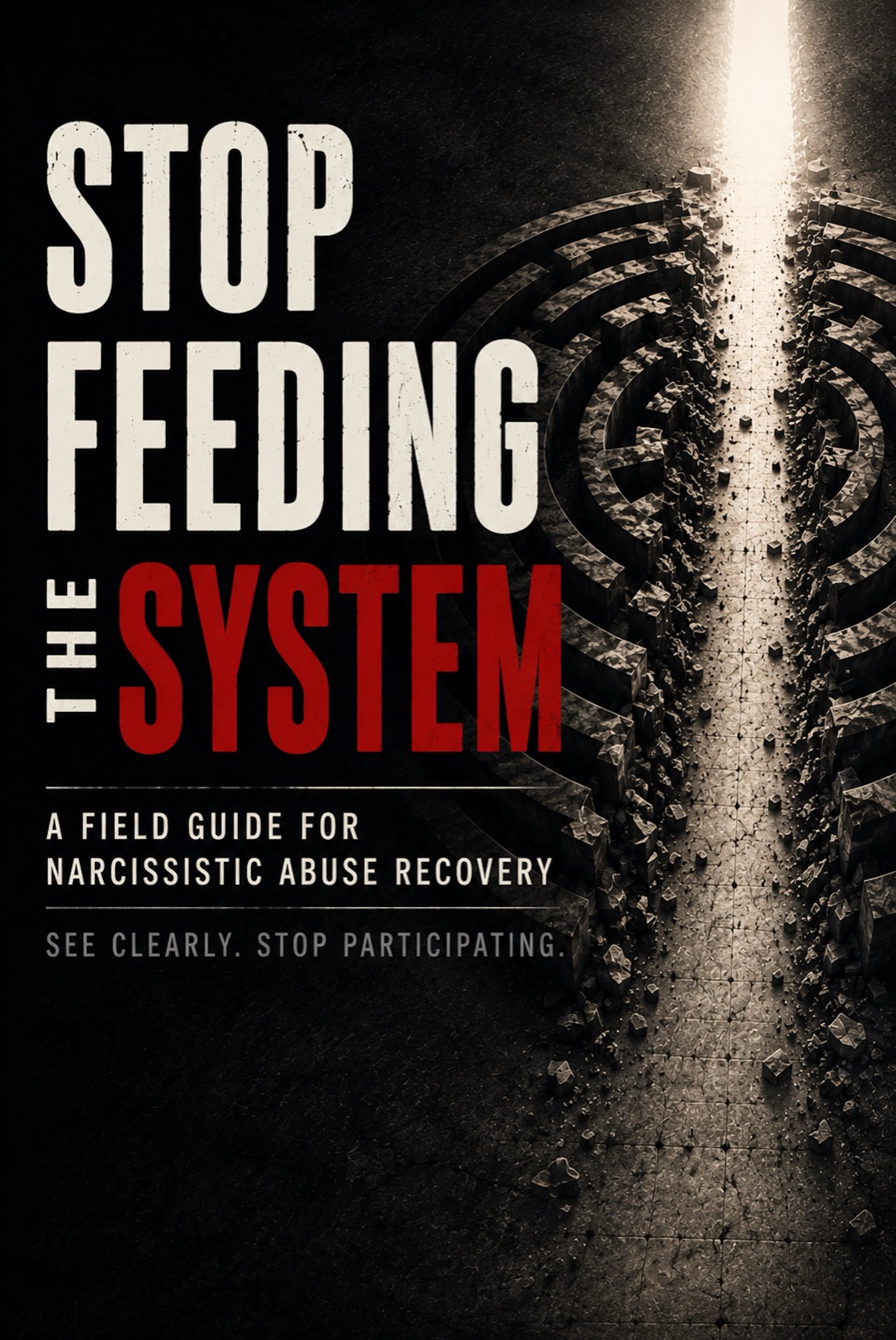
Stop Feeding the System book cover

About the book

If the fight never finishes, it isn't a fight. It's a feeding schedule.

Most people inside a long-form narcissistic relationship spend years trying to be understood. They write the careful message. They take the share that was theirs. They go back to the room hoping that this time the truth will land. The truth does not land. The room does not work that way.

Stop Feeding the System is a field guide for the person who has worked out that the loop they are inside does not run on conflict rules. It runs on supply. Reaction, explanation, rescue, secrecy, reputation protection, money, sex, time. The system feeds on what you give it. The work of getting out is the work of seeing the supply and, line by line, refusing to keep providing it.

The book is built around a set of named tools — the Pattern Ledger, the Supply Audit, the Repair Test, the Pause, the Three Conversations, the Contact Ladder, the Specialist Brief, the Self-Trust Rebuild Protocol — that appear chapter by chapter and work as a set. By the time the reader reaches the end, they have a private operating kit.

It is not a diagnostic book. It is not asking anyone to confront, leave, or stay. It is asking the reader to see what is in the room, stop feeding what is feeding on them, and rebuild the self the system trained them to doubt. What they do with that seeing is theirs.

Back cover text

Where you need a map, this is one.

Most books on narcissistic abuse tell you what to call the other person.

This book gives you a way to know what is happening.

Not from a diagnosis. Not from one bad night. Not from a video checklist at two in the morning. From the pattern. From what happens after harm is named. From what changes, what repeats, what gets denied, what gets rewritten, and what it costs you each time you try to make the truth land.

If you have lived inside a closed-loop relationship long enough, certainty becomes the first thing taken from you. You know what happened, then doubt it. You see the pattern, then explain it away. You write the careful message. You take the share that was yours. You wait for repair. Then the same machine starts again, with a different label on the front.

Stop Feeding the System is a field guide for the reader who already knows something is wrong but has been trained to mistrust the knowing.

It does not ask you to diagnose the other party. It does not tell you to confront, leave, or stay. It gives you a private way to gather evidence, recognize the loop, test for repair, reduce the supply being extracted, and rebuild self-trust one verified action at a time.

The work is not to win the argument.

The work is to stop using the argument as the place where reality gets decided.

Written by a survivor of five decades inside narcissistic systems, first as a child, then as a partner, this is not a clinical text. It is a map for the person sitting somewhere quiet, probably late, probably tired, half convinced they are the problem.

Where you need professional help, this book cannot replace it.

Where you need a map, this is one.

Editions

Read it now. Hear it later. Work through it next.

The full book is available now in Kindle and paperback editions. Audiobook and guided course editions remain in production.

Template download

Book templates by email

Get the printable worksheet templates from the book. The secure download link is sent to your inbox and expires after 24 hours.

i.

Kindle
Edition

The complete book as a Kindle edition. For the reader who needs the chapter tonight, not the parcel next week.

Format Kindle Price $9.99 USD
Buy Kindle
ii.

Paperback
Edition

A physical copy, printed and bound. The field exercises were written to be done by hand. The book was written to be marked up, dog-eared, kept beside the bed.

Format Trade paperback Price $18.99 USD
Buy paperback
iii.

Audiobook
Edition

Narrated by the author. For the commute, the long walk, the early hours before the house is awake. The voice the book was written in.

Format MP3 Narrator Lee Powell
Coming soon
iv.

The Practical
Recovery Course

A guided course built on the book's operating system. Video modules, worksheets, and the field exercises walked through in order. For the reader ready to put the tools to work.

Format Video + workbook Hosted at Holistica
Coming soon
A short orientation

What this book is. What it is not.

This is

  • A field guide from inside the room
  • An operating kit of named tools
  • Written by a survivor of five decades inside the system
  • Built for the reader who already knows something is wrong
  • Modular — read it in any order the night requires
  • Reviewed by a trauma-informed clinician and a family lawyer

This is not

  • A clinical text or a diagnosis
  • A book about confronting, leaving, or staying
  • Another explanation of what a narcissist is
  • A healing journey
  • A replacement for specialist help
  • An invitation to label the other party
The named tools

An operating system, not a pep talk.

i.

Pattern Ledger

The private log that turns scattered incidents into a recognisable shape. The first work of seeing.

ii.

Supply Audit

Eight categories. Four columns. The honest accounting of what the system is being fed, and at what cost.

iii.

Repair Test

The ten-minute conversation that tells you whether repair is possible — or whether what is on offer is its counterfeit.

iv.

The Pause

A four-step sequence for installing the gap between the lever and the reaction. The engine that lets the other tools run.

v.

Three Conversations

The architecture of who hears what. The page, the practitioner, the reality witness. None of them is the other party.

vi.

Contact Ladder

From low contact through grey rock to no contact. The stepped framework for reducing surface area without theatrics.

vii.

Specialist Brief

How to walk into a lawyer's office, a clinician's room, a domestic-violence service, with the information they need to help.

viii.

Self-Trust Rebuild

The slow work of getting back the interior the system trained you to doubt. One verified action at a time.

Who this book is for

The reader the book is written for is the one sitting somewhere quiet, probably late, probably tired, half convinced they are the problem.

If that is you, you are in the right place.

— From the introduction
The author

Lee
Powell

Lee Powell writes and builds around the systems people find themselves inside before they can see them. He is the author of Stop Feeding the System, ManOS, and the novel LOADED, with The Witness Layer forthcoming. Before returning to books, he built software used by writers worldwide, including Scrivener and Scapple for Windows. He holds an MSc in Software Engineering from the University of Oxford. His paintings are held in private collections internationally.

Stop Feeding the System is not a clinical text. It is what happens when a person who spent fifty years inside the room sits down, after the fog clears, and writes the field guide that did not exist when he needed it.